Tuesday, June 28, 2011

Review: The Easter Parade by Richard Yates

Title: The Easter Parade
Author: Richard Yates
Pages: 226
Genre: Contemporary Fiction
Release Date: January 1, 2004
Publisher: Methuen
Source: Personal Copy

During a trip to my favorite used bookstore, I came across a paperback copy of The Easter Parade in the bargain section. All I knew of Richard Yates before beginning this book was his reputation for writing about middle-class suburbia. While I haven't read his most popular book, I did see the movie Revolutionary Road, so I had an idea of what to expect. Plus, the cost was only $.75, which I just couldn't pass up. My decision was completely validated after finishing the whole thing Friday.

Starting from the 1940s, The Easter Parade is a heartbreaking tale of two sisters and the ups and downs in their lives over the span of forty years. Emily and Sarah's adolescence is spent dealing with the divorce of their parents: the flaky and erratic 'Pookie" and the alcoholic and absentee Walter. From here the lives of these two different personalities take very divergent paths. Sarah becomes a traditional suburban wife and mother at an early age, while Emily focuses on her career and a string of men who never quite seem to fit. Although they make different choices, both want to find the elusive state of happiness. Yates creates a intricate story about the regret, resignation, and repression that afflict the Grimes family.

'I don't get it,' Emily said.
'Oh, Emmy,' Sarah said. 'How many people know what "capitulate" means?'
'Do you know what it means?'
Sarah blinked. 'Well, but I mean how many other people do? And for a daily newspaper that's supposed to reach millions of people - I don't know; I thought it was funny, that's all.'

Most of the narrative stays with Emily, but there are moments when glimpses of Sarah's life are revealed. Some of the most compelling scenes involved the interaction between the two sisters. Yates does an excellent job conveying the envy and pity these two hold for each other. Both seem unsatisfied with their own situations and long to be in the other's shoes. The portrayal of the relationship between the women is very realistic, and I think many siblings feel this way to some degree. There is very much a presentation of opposing views of womanhood, wife/mother vs the single career girl, and the few males that are in the narrative are relatively weak.

School was the center of [Emily's] life. She had never heard the word 'intellectual' used as a noun before she went to Barnard and she took it to heart. It was a brave noun, a proud noun, a noun suggesting lifelong dedication to lofty things and a cool disdain for the commonplace."

After finishing The Easter Parade, I can see why Yates is considered a master of telling the unsentimental story of the small middle-class life. He is one of the few authors that can create a full story in so few pages. The prose is very succinct, and hits it's mark perfectly tackling issues of alcoholism, life dissatisfaction, and dysfunctional families with such emotional depth. At the heart of the story is the failure of the American Dream.

Monday, June 27, 2011

Review: 31 Bond Street by Ellen Horan

Title: 31 Bond Street
Author: Ellen Horan
Pages: 368
Genre: Historical Fiction
Release Date: April 1, 2010
Publisher: Harper
Source: Personal Copy


MYSTERIOUS MIDNIGHT MURDER
AN EMINENT CITIZEN ARRESTED
INTENSE EXCITEMENT IN BOND STREET
An atrocity, almost unparalleled by any of the atrocities committed in this City, came to light on Saturday morning in the house at No. 31 Bond Street. Dr. Harvey Burdell was found in his office, foully murdered, and frightfully and fiendishly mutilated. Dr. Burdell was a man of considerable wealth, and respectably connected.                                                -The New York Times, 1857

Sounds exciting, huh? Yeah, that's what I thought too...until I finished the book. I mean, when you have a Victorian murder mystery based on a real life case and set in one of the greatest cities in the world, what's not to like? While being quite a fast read and somewhat entertaining, 31 Bond Street, unfortunately, had too many negatives to keep it from being stellar.

Set in rapidly growing New York City during the 1850s, the novel opens up with the discovery of Harvey Burdell's deceased body by a young servant boy named John. After notifying the local authorities, Emma Cunningham, whose status within the house is questionable, and her two daughters are quickly quarantined inside the brownstone by a brash and hostile coroner. It is during the coroner's investigation and inquisition that lawyer Henry Clinton begins representing Emma. From here, the novel uses a flashback format that depicts Emma's viewpoint for the chapters set in the past. These chapters detail how Emma came to be living in the upstairs of Dr. Burdell's home and helps provide a little insight into her character. The trial is the focus of the present day chapters with the innocence or guilt being determined over the following weeks, and also serves to highlight the rampant corruption within both the government and the well-to-do citizens of the city.

Some of the best parts of this book were the description of the city at that time in history. Horan does an excellent job of revealing and detailing daily life, and expressing the dichotomy of the fast modernization of a people that still hold on to certain traditions. The inclusion of actual newspaper quotes and clippings added a layer of authenticity and helped set the tone for the story. The novel definitely underscores the sensationalistic media of the day, which I found quite interesting and not quite so different from the media of the current day. The medium may have changed, but the methods remain the same.

The descriptions of the actual trial were what stood out as most compelling. The practice of law is quite fascinating to me, and I definitely enjoyed the back and forth between the lawyers. Henry Clinton's thoughts and actions while composing and delivering his arguments came across as genuine. This may be due in part to the book he wrote depicting the trial. Horan mentions reading Extraordinary Cases and Celebrated Trials while doing her research, and I think this comes across in the narrative. Without the first person account, I don't think this section would have been nearly as strong.

While 31 Bond Street was a page turner, I didn't feel a connection to any of the characters. I felt the depiction of Emma was a little too 'nice.' She came across as very naive, but I just don't buy that. In the author interview at the back of the book, Horan talks about the struggles of middle aged women during that time who did not have "protection" in the form of husband, and how they were quite likely to descend into poverty. Based on this assessment, I don't see Emma, a woman struggling to stay afloat, as being so innocent in every facet of her life. After doing a little research on my own, I realized there were many facts about Emma's actions during the trial that Horan left out. I think that if these scandalous bits had been included the book would have been more enticing.

As it stands, I was ok with the book until part four. I do wish there had been more flashbacks to Emma's past, as I found these chapters vastly more entertaining than the ones describing Henry Clinton's life outside the trial. The first 2/3 of the narrative was a little cut and dry, which wasn't terrible, but it didn't match up with the runaway train that was the last part of the story. I felt that both the story and the writing took vastly different directions once there were no more facts and complete fiction took over. The ending seemed very rushed and didn't feel very well thought out. The book wouldn't have lost as much in my eyes if it had stopped after the trial, instead of descending into unrealistic territory.

Although Horan doesn't shy away from including the social, racial, and gender issues of the day, the unmemorable characters and unseasoned writing kept this one from being a winner. I was expecting more of an engaging telling of the facts regarding this real life murder mystery. I can't say I recommend this one unless you have an undying love for Victorian murder mysteries and must read all that have been written.

Wednesday, June 22, 2011

Review: The Peach Keeper by Sarah Addison Allen

Title: The Peach Keeper
Author: Sarah Addison Allen
Pages: 288
Genre: Contemporary Fiction
Release Date: March 22, 2011
Publisher: Bantam
Source: Personal Copy


Sarah Addison Allen has become my go-to writer for heartwarming comfort fiction. I've now read three of her books and can safely say she has yet to let me down. Some people may categorize her work as chick lit, but I would disagree. Allen's fiction chooses to focus on strong women with normal lives and normal problems. As a writer she has the ability to capture the heart of the small southern town and really make you perceive with every one of your senses. Delving into the worlds that she creates is such a delightful treat.

Walls of Water, North Carolina is a town full of secrets, superstitions, and traditions. Willa Jackson, whose family was once the richest in town, is trying to make a life for herself separate from her family legacy and her high school image as The Joker. She runs a store that sells outdoor supplies and coffee in the tourist part of town in an attempt to isolate herself from the life she once knew. Paxton Osgood is a socialite with good intentions who has begun to restore The Blue Ridge Madame, the grandest mansion that was once owned by the Jackson family generations ago. It is this house and the secrets buried beneath the peach tree in the front yard that begin to connect Paxton and Willa. Through this unlikely alliance, the two girls must delve deeper into the history of the town and of their own grandmothers in the hopes of unraveling the mystery of long forgotten secrets, life changing betrayals, and everlasting friendships.

The Peach Keeper was such an engaging read from start to finish. I was captivated from the beginning and couldn't put the book down, which is exactly why I love Allen's work so much. You can really get lost in her writing, and she has an excellent way drawing you into the story with her vivid descriptions. Her past novels have more of a food focus, but this one used nature to create such a luscious atmosphere. From the descriptions of the national forest to the majesty of old southern architecture, I found myself desperately wanting to take a road trip to North Carolina and experience the beauty myself.
Because we're connected, as women. It's like a spiderweb. If one part of that web vibrates, if there's trouble, we all know it. But most of the time we're just too scared or selfish or insecure to help. But if we don't help each other, who will?
As for the characters, I was really impressed with how strong and brave the females were, both for themselves and for others. There was such an emphasis on friendships and, as you can tell from the quote above, women sticking together. I definitely enjoyed Paxton more that I thought I would. She is different from the usual Allen protagonist, and I was afraid at first that the story of the two girls wasn't going to meld well together. I've read two other books by the author, and normally the pretty rich popular girl isn't the focus. Luckily, Allen is able to create such a likable character to which I think a lot of people can relate. Weighed down by obligations to her family and community, Paxton spends her life trying to please everyone else and neglecting her own needs. The focus is never on her wealth or her status but her job, her relationships, and her dreams. This is why I think the story lines of Willa and Paxton were able to coexist successfully.

Now for the few qualms I had with the book. I felt that The Peach Keeper was missing some of the magic that made her previous novels sparkle. There was talk of ghosts, superstitions, and a travelling salesman with abilities in the past, but there wasn't that element in the present day storyline to be able to call it magical realism. Probably the only reason this bothers me is because I was expecting it based on past readings, but this lacking doesn't detract from the overall story. If this had been my first Allen book then I think I would have enjoyed it more since I wouldn't have had the expectations. Also, I wish that there had been more focus on the past, especially on the grandmothers. I loved Agatha and wish she could have been a more well-rounded character. For me, an addition of fifty pages or so would have allowed for a few more flashback chapters, making the story feel more complete.

Overall, Sarah Addison Allen has created another engaging and whimsical winner. The pacing of the mystery angle was excellent, with little morsels being slowly revealed at the right moments. The is also a little treat for fans of her other book Garden Spells in the form of a character guest appearance. The Peach Keeper is a tale of buried secrets, the journey one must take to become free from the past, and the enduring bonds of friendship, family and tradition. While not my favorite Allen book, I completely recommend this one, especially during the lazy days of summer.

Tuesday, June 14, 2011

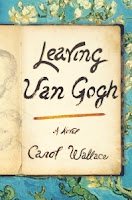
Review: Leaving Van Gogh by Carol Wallace

Title: Leaving Van Gogh
Author: Carol Wallace
Pages: 268
Genre: Historical Fiction
Release Date: April 19, 2011
Publisher: Spiegel & Grau
Source: Personal Copy

One of the requirements for my undergrad degree was to take a fine arts elective, which I decided to fulfill during a summer semester. There weren't many options, so I wound up taking Introduction to Art History. It turned out to be a favorite class of mine. One of the best aspects of the class was the broad focus. I learned so much about techniques and was introduced to some of my favorite artists, including Diego Velázquez and his painting Las Meninas. This was the class that truly helped me appreciate painting and the masters like Vincent van Gogh. Ever since finishing that class I've been fascinated by the history behind the great artists, and that is why I picked up Leaving van Gogh.

In the author's note at the end of the book, Wallace reveals that this story came about after researching printmaker Charles Méryon for her master's degree. Once she realized that the Dr. Gachet that treated Méryon for madness was the same one as depicted in the van Gogh portrait of the same name, her writing took a turn to focus on the famous painter. After performing countless hours of research, the author presents her take on van Gogh's final days. Much of the story is constructed using over 900 letters van Gogh and his brother Theo exchanged. Knowing this gives a certain weight and depth to the narrative that might not otherwise be present.
What must it be like, to know yourself untrustworthy, to have something take over your free will? Was it like being possessed? It is difficult enough to live, knowing one's strengths and limitations. But most of us stumbling through life do not bear the burden of knowing that we may turn into monsters.
Leaving Van Gogh is told from Dr. Gachet's point of view and takes place in the small town of Auvers in the French countryside. Gachet's wife has passed from tuberculosis, and he lives with his son, daughter, and housekeeper. Van Gogh's brother Theo comes to the doctor to seek his help in caring for the artist after his release from the St. Rémy asylum. Gachet's background is in mental illness, and he's worked in two hospitals. That experience combined with his own skills and appreciation for painting makes him the perfect candidate to care for the ailing van Gogh. The rest of the story focuses on the trials suffered by both doctor and patient. I don't want to give anything away, but if you know anything about van Gogh's life then you know how the story will unfold.

For me, the descriptions of the paintings are where the novel excelled. Many people considered these parts to be too technical, but I found them most appealing. Wallace was definitely able to convey how great an artist van Gogh truly was, from simple portraits to sweeping landscapes. I often found myself online searching for a particular work described, and that gave the overall reading a nice visual layer.

While this was a fascinating look at van Gogh's illness, I wasn't as completely absorbed in the narrative. I enjoyed the story overall, but I felt a little restless at times and lost focus. The writing was a little on the academic side, which is what I think kept me from feeling more connected to the characters. The author didn't take too many liberties with the historical facts, but I wish there had been a little more action as the plot wasn't very meaty. The more I learned about the doctor, the less I cared for him. He comes across as indifferent and is often harsh and uncaring towards his children. A lot of the story focused on Dr. Gachet's life apart from van Gogh, including his time at the mental hospital and his wife's death, and this is where I felt the narrative began to drag. I wish Wallace had kept the focus a little more on Vincent, but that's more of a personal preference.
Who has not felt a shroud of melancholy, that pull of listlessness that devalues any effort and washes all color to gray? Who has not become attached to a notion and blindly refused to see reason? Who has not chosen to see himself as something entirely other than what he is?
I haven't read any other accounts of Vincent van Gogh's life, so I can't really say if this would be a decent introduction for someone who knows little. While the plot may not have engrossed me, I do think Leaving Van Gogh was a very insightful look at the debilitating effects of extreme anxiety and mental illness. Wallace does create a haunting portrait of an artistic genius with many inner demons and a lost spirit. An overall sense of melancholy consumes the novel, and it definitely is not an uplifting read. If you are a fan of van Gogh's work or interested in psychology/mental illness then I would recommend reading this, but for anyone else I say skip.

Sunday, June 12, 2011

Sunday Edition: Irish Cream Brownies


It is amazing how many types of brownie recipes one can choose from when deciding what to bake. There is so much variety among them that it's easy to find one for any taste preference. Most bakers have a favorite go-to recipe (mine is a thinner brownie that uses unsweetened chocolate and includes walnuts), but sometimes it's nice to venture out and try something different. That's exactly what I decided when I saw this recipe for Irish Cream brownies.

During the summer a lot of my recipes begin to include alcohol. That subtle added kick is just perfect for the end of a long hot day. I had never made anything using Bailey's, but I do enjoy it in the occasional cocktail, so I decided to give it a go. Sometimes recipes using liquor can have too strong an alcohol taste, but this version came out just right. The frosting was actually less sugary/sweet than I was expecting, which was a good thing as I usually tend to dislike it on my brownies.

Overall, this brownie had a slightly cake-like texture and the chocolate chips gave an added crunch. I think this would also appeal to those who are not particularly fond of brownies but who do enjoy a frosted cake. This easy to make treat would be perfect for any chocolate lover!


Irish Cream Brownies
    Recipe from Cookie Madness
Ingredients:
-4 oz/114 grams unsalted butter
-4 oz /114 grams semi-sweet chocolate (I used Ghirardelli)
-1/2 cup/ 98 grams granulated sugar
-1/4 cup Irish Cream
-2 large eggs
-1 cup (4.5 oz/126 grams) flour, spoon and sweep or fluff up and scoop if you don’t have a scale
-1/2 teaspoon baking powder
-1/4 teaspoon salt
-1/2 cup mini semi-sweet chocolate chips (or regular size morsels if that’s all you’ve got)

Irish Cream Frosting
-2 oz/56 grams cream cheese, softened
-1 tablespoons unsalted butter, softened
-2 tablespoons Irish Cream
-1 ½ cups powdered sugar

Directions:
Preheat oven to 350 degrees F. Line an 8 inch metal pan with non-stick foil.

Melt the butter in a microwave-safe mixing bow. Add the chocolate and stir to coat with melted butter.

Microwave at 50% power (high would probably be okay too) for 30 seconds. Stir and repeat until chocolate is melted.

Stir in sugar, then beat in the Irish Cream. Beat in the eggs, one at a time, then beat in the baking powder and salt. Using lowest speed of mixer or by hand, mix in the flour. Stir in the chocolate chips.

Pour into pan and bake on center rack for 22 minutes or until brownies test done. Let cool completely in pan set on a rack. Make the frosting when cool.

To make the frosting, mix all the ingredients together and beat until light and creamy. Frost the brownies when they are cool.

Lift from pan, set on a cutting board and cut into 16 squares.

Wednesday, June 8, 2011

Thrifty Book Finds


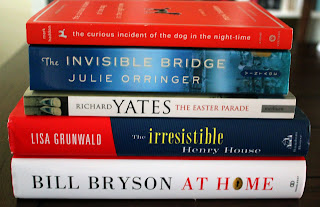
Over the weekend I had the opportunity to make a day trip with some of the girls in my book club to a huge used bookstore in Tennessee called Mckay Books. The prices vary so you have to make sure to find the best deals. I absolutely love the selection of classic novels. There is also a bargain section where I found two of my selections, The Easter Parade and The Curious Incident of the Dog in the Night-Time for $1 and $.75 respectively. So of course I had to feed my book buying addiction when I went, and these are what I left with, although I had many more which I had to force myself to put back.

Some of these selections were chosen based on great book reviews from other bloggers. What would I do without all the great recommendations? Well, other than have a much smaller TBR pile. :-)

- The Curious Incident of the Dog in the Night-Time by Mark Haddon - I'd been eying this one for years in various bookstores, but never picked it up for some reason. When I saw this copy was only $.75 I thought 'Why not?' Plus, Brenna at Literary Musings included it in her Top Ten Beach Reads, so I figured this would be a great time to read it.

-The Invisible Bridge by Julie Orringer - Longlisted for the Orange Prize, this is Orringer's first novel. This is one of the few selections that I was interested in that is easily available in the US. It's a long one at 600+ pages, but it sounds like such an epic and sweeping tale of family and love. 

-The Easter Parade by Richard Yates - I've never read Yates' most famous novel Revolutionary Road, but after reading Diane at Bibliophile by the Sea's review of a few of his other works, including this one, I knew I had to add it to my pile. 

-The Irresistible Henry House by Lisa Grunwald - A member of my book club mentioned this title as a potential pick a few months back. It wasn't chosen, but the book sounded so interesting I added it to my list. NPR's All Things Considered featured an interview with the author that I highly recommend. Such an intriguing and controversial topic.

-At Home by Bill Bryson - My first Bryson was the ever-popular A Walk in the Woods, which I read earlier this year. While the story wasn't the greatest, I really enjoyed his writing style and wanted to give one of his other works a chance. What better book to pick than one that details the history of the house?

Well, those are my most recent thrifty book finds. What have been some of yours?

Monday, June 6, 2011

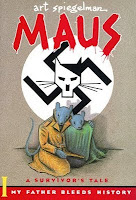
Review: Maus - A Survivor's Tale: My Father Bleeds History

Title: Maus - A Survivor's Tale: My Father Bleeds History
Author: Art Spiegelman
Pages: 160
Genre: Graphic Novel
Release Date: November 1, 1991
Publisher: Pantheon
Source: Personal Copy

I think the Holocaust has to be one of the hardest periods in time on which to base a novel. How much descriptive detail does a writer need to provide? Should there be more focus on the fictional characters or the factual events that occurred during such a horrific tragedy. Art Spiegelman uses a graphic format to present the story of his parents during World War II as told by his father Vladek. The two have a very strained relationship, and many issues come up during the course of the novel that they must work through. I think this was almost a cathartic exercise for the author.

Does the medium fit the horror of the Holocaust? I think in some ways yes. Seeing the visual representations of certain things, such as the character of Artie’s graphic story of his mother’s suicide, were very gut-wrenching, and I definitely felt the effects more deeply than I would have with just the words. Sometimes it becomes easier to gloss over some of the more horrific aspects, but when there are pictures right in front of your eyes it’s a lot harder to ignore. Germans are represented as cats, the Jewish are represented as mice, and the Polish are represented as pigs. The artwork was minimal but detailed, which came across as much more powerful.

I haven’t read many graphic novels, but when I saw this one at the local Goodwill I decided to give it a shot. Maus is such a heartbreaking yet compelling story of the resilience and flexibility of an entire generation of Holocaust survivors. Spiegelman was very honest in his portrayal of both himself and his family. No group of people or individual character was left unscathed. Jewish people constantly sold each other out in the hopes of avoiding being transported to a camp. Poles would help hide Jews, but only as long as they were being paid. There was a definite sense of the deceit and complete collapse of morals among some citizens during that time. Even during the present day parts, Artie comes across as impatient and a little self-serving, while Vladek treats his second wife poorly, is stingy, and quickly loses his temper. However, Spiegelman sympathetically portrays the characters' actions as understandable and somewhat logical.

This story fluidly moves back and forth in time making the timeline easier to understand. Overall, Spiegelman does an excellent job of recounting the past, which is almost impossible to represent accurately since memories tend to become biased over time. Maus is a very poignant look at the devastation and consequences that come from viewing people as animals and treating them as such. I very much look forward to continuing the story with Maus II.

Sunday, June 5, 2011

Sunday Edition: Buffalo Chicken Salad w/ Blue Cheese Dressing


My last few Sunday posts have been driven by my sweet tooth, so today I figured I'd feature something a little more savory. Today's recipe comes from Clean Eating Magazine, which I absolutely adore. There are so many great tips for eating healthy and seasonally, and I've found some of my all-time favorite recipes between the covers. Obviously, the focus is on eating food that is as close to its natural state ("clean") as possible without any preservatives or other additives. For me, there is nothing better than taking a bite of something fantastic that I know is fresh and good for me. I highly recommend this publication to anyone who wants to watch what kind of food they put into their bodies.


The Buffalo Chicken Salad w/ Blue Cheese Dressing has definitely become a go-to recipe of mine, especially when I make the chicken ahead of time. When the heat starts to rise, I begin enjoying salads even more because standing in a hot kitchen for an hour or more is not something I'm as willing to do. Luckily, this salad tastes amazing! The blue cheese dressing uses Greek yogurt so the texture is a lot thicker and creamier. Adding paprika and chili powder to the chicken before broiling definitely gives it a kick. As with any salad, you can easily substitute any veggies to suit your taste preferences. I love how the carrots and grape tomatoes make the salad really pop with color. This is a great salad to have on a summer afternoon, and with less than 300 calories for the plate it leaves room to enjoy a delicious after dinner dessert or margarita!


Buffalo Chicken Salad w/ Blue Cheese Dressing
    recipe from Clean Eating Magazine

Ingredients
-1 lb boneless, skinless chicken breasts
-Olive oil cooking spray
-1 tsp smoked paprika
-1 tsp chili powder
-1/8 tsp sea salt
-1/2 sweet onion, chopped (about 1/2 cup)
-1/2 cup nonfat plain Greek-style yogurt
-5 tbsp low-fat buttermilk
-1 to 1 1/2 tbsp all-natural hot sauce
-1 head romaine lettuce, thick spines removed, chopped
-1 head red leaf lettuce, thick spines removed, chopped
-1 yellow bell pepper, thinly sliced
-1 pint grape tomatoes, halved
-1 cup peeled and shredded carrots
-2 oz blue cheese, crumbled (about 1/2 cup)

Instructions:

Preheat broiler to high. Place chicken on a baking sheet coated with cooking spray. Lightly mist chicken with cooking spray and sprinkle evenly on both sides with paprika, chili powder and salt. Broil 6 to 8 inches from heat until center of chicken is no longer pink, about 6 minutes per side. Transfer chicken to a cutting board and let rest for 3 to 5 minutes before cutting into bite-size chunks.

In a blender, puree onion, yogurt, buttermilk and 1 tbsp hot sauce. Taste and add remaining hot sauce if you want more heat. Divide romaine and red leaf lettuces among 4 plates and top with bell pepper, tomatoes, carrots, and chicken, dividing each evenly. Serve yogurt mixture on the side or drizzle evenly over each plate. Sprinkle with blue cheese and serve immediately.

Wednesday, June 1, 2011

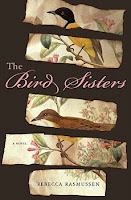
Review: The Bird Sisters by Rebecca Rasmussen

Title: The Bird Sisters
Author: Rebecca Rasmussen
Pages: 290
Genre: Contemporary Fiction
Release Date: April 12, 2011
Publisher: Crown
Source: Personal Copy


Now that the Memorial Day weekend has passed, summer has officially begun for me. During the long, hot, and lazy days of the season in the south, a cold glass of lemonade and books like The Bird Sisters are what keep me going. I couldn't help but picture myself roaming around a quiet peaceful farm observing nature undisturbed. Such a wonderful image! I finished this book a couple of days ago, and I have been trying to write a review ever since. It is almost impossible to do any justice to a book that surpassed my expectations, but I will try anyway. As I wrote in my post yesterday, this book definitely belongs in every one's beach bag!

The Bird Sisters begins in the present day on the farm owned by sisters Milly and Twiss in Spring Green, Wisconsin. A stranger has brought an injured goldfinch to the women, who have garnered a reputation among the locals as bird healers, in the hopes that the bird can be saved. Unfortunately, the goldfinch does not survive, which results in an afternoon spent reminiscing about the summer of 1947. The summer that changed both their lives forever.
Once a bird had lost his ability to fly, not much else could be done in the way of mending him. Losing a wing was a little like losing a leg and the freedom of movement, of spirit, it granted you; most people could live without the former but not the latter.
From the beginning, we know that the two sisters end up living together as spinsters in their childhood home. The real question lies in how they came to be in this position. Finding the answer to this question is exactly what kept me turning page after page. Through chapters that alternate between the past and the present, Rasmussen eloquently tells the story of a small town family who is forced to face many challenges throughout that fateful summer.
If in marriages disagreements were like roots, their mother and father’s were like the roots of the oak tree in the backyard that had grown into the house instead of away from it, cracking the foundation and setting the floors aslant.
Bordering on being an absentee father, Joe spends his days at the golf course trying to recapture his dreams of fame, while his wife Margaret begins to regret her marriage. This tumultuous relationship is further agitated by the arrival of Twiss and Milly's cousin Bett who brings her own set of issues to the mix. I don't want to give much more away, as I think the unfolding of events is what makes this novel so beautiful. However, I will say that the trials that Milly and Twiss endure are a testament to the strong bond between sisters. They must make decisions that have lasting consequences, but support each other through everything.
A bird’s wing, though it contained several distinct bones, functioned as though it contained only one. You couldn’t fiddle with even the tiniest bone without repercussions in the larger ones.
The Bird Sisters is full of beautiful, heartfelt prose and unforgettable characters. Rasmussen expertly weaves the multiple layers of this bittersweet, character-driven book. The bird symbolism was there, but it was very subtle. I always appreciate an author who assumes that readers are astute. Overall, this coming of age story was about how these two sisters deal with a loss of innocence, and their resilience even when their dreams fail to come true.

Now, a review of this wonderful book would not be complete without mentioning how great author Rebecca Rasmussen is. She is so supportive of her readers and book bloggers, and it definitely comes across as genuine. She has her own blog and has a very active presence on Twitter. I've never had the opportunity to interact with an author in such an informal way, and I definitely think this added to my reading experience. I very much look forward to her next book!