Thursday, September 22, 2011

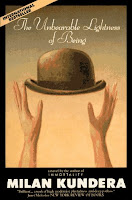
Review: The Unbearable Lightness of Being by Milan Kundera

Title: The Unbearable Lightness of Being
Author: Milan Kundera
Pages: 306
Genre: Contemporary Fiction
Release Date: November 12th, 1988
Publisher: Harpercollins
Source: Personal Copy

We can never know what to want, because, living only one life, we can neither compare it with our previous lives nor perfect it in our lives to come.
In the opening pages of The Unbearable Lightness of Being, Milan Kundera directly challenges Nietzsche's concept of eternal return, which is the idea that everything we experience has occurred before and will continue to recur infinitely. This novel follows the lives of four characters to highlight the alternative. Kundera's basic argument is that because we only live one life, the decisions we make are insignificant. The idea that our choices don't have any universal significance is perceived as an unbearable lightness.

Kundera's extremely philosophical novel centers around two couples during the Soviet occupation and rise of communism in Prague during the late 1960s. Tomás is a successful surgeon with a penchant for serial womanizing, while his wife Tereza is a photojournalist with many psychological issues concerning her body. Also there is Sabina, a young artist who elates in the act of betrayal. While being Tomás's mistress she also starts an affair with the married Franz, a professor in Geneva. Kundera uses these four people to explore the themes of weight, sexuality, and fate while showcasing the human struggles with fidelity, love, family, and Communism.
The only certainty is: the lightness/weight opposition is the most mysterious, most ambiguous of all.
That quote basically sums up my experience reading The Unbearable Lightness of Being. While the philosophical musings were thought provoking, I had a hard time truly understanding the message Kundera was trying to get across. Much of the novel feels quite choppy with short chapters that jump between the different viewpoints of the characters. At times the narrator himself takes over and begins meditating on his own ideas which, while adding an additional layer to the characters' psyches, only emphasizes the uneven narrative structure. I don't think this is necessarily a negative though, and feels more like a mimic of life as it is messy and rough as well.

When I finished I was immediately aware of the fact that to truly grasp and understand what Kundera was attempting to convey I would have to reread the book. This speaks to the existential and philosophical nature of the text. Without close attention, the narrative can become muddled, and I definitely don't recommend reading this one at night before bed. The characters are not fully fleshed out, and are used more as examples to explain Kundera's ideas. I do think this book presents some interesting viewpoints and food for thought; however, I can't say I was satisfied after reading this one. Maybe if I had a group to discuss and dissect the text with I would have gotten more out of it than I did. I can see why this is considered a modern classic, but for me this was only mediocre.

Tuesday, September 20, 2011

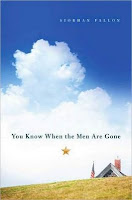
Review: You Know When the Men Are Gone by Siobhan Fallon

Title: You Know When the Men Are Gone
Author: Siobhan Fallon
Pages: 225
Genre: Contemporary Short Story Fiction
Release Date: January 20th, 2011
Publisher: Penguin
Source: Personal Copy

At the Fort Hood military base outside of Killeen, Texas live many military spouses, mostly women. Whether their significant other is off fighting in other parts of the world or working long hours in an office across town, these women must learn to deal with the stress of running a household alone and many must wonder daily whether their husband has survived another day of war. Siobhan Fallon writes eight loosely interconnected short stories that delve into the personal lives of military families and offer an inside look into their homes, friends, and marriages.
You also know when the men are gone. No more boots stomping above, no more football games turned up too high, and, best of all, no more front doors slamming before dawn as they trudge out for their early formation, sneakers on metal stairs, cars starting, shouts to the windows above to throw down their gloves on cold desert mornings. Babies still cry, telephones ring, Saturday morning cartoons screech, but without the men, there is a sense of muted silence, a sense of muted life.
Ms. Fallon's collection does an excellent job of examining the different aspects of life as an army wife from the friendships formed with other wives to the effects that a returning injured soldier has on people. There is the story of Meg, a woman who becomes obsessed with her new neighbor, Natalya, and begins spending her evenings listening to her every move through the paper thin walls of her army housing apartment. Ellen's story about a woman diagnosed with cancer who spends the day searching for her missing children highlights the fact that just because your husband works on the base does not mean that he is around. My favorite of the stories is the tale of Cristina Diaz, who must confront the possibility that her husband is cheating on her with a female private in Iraq.

From start to finish I really enjoyed this collection. While there is definitely heartbreak and bittersweet undertones, You Know When the Men Are Gone offers a compassionate look at military families dealing with effects of both deploying and returning soldiers that I don't think is often acknowledged. There are many themes that Fallon explores such as infidelity, loneliness, anxiety, and doubt that are universally applicable and to which any reader can relate. The sense of loss, whether it is a spouse, a limb, or a life, hangs in the air of most of the families in some way or another, and I found myself wanting to reach out and comfort many of the characters.

Overall, You Know When the Men Are Gone really stood up to the test that I think many short story collections fail. The prose was crisp without coming across as overly simplistic. The detailed sense of place that Fallon created over the course of the eight stories highlights Fort Hood as the main character. The place comes alive with the sights and sounds of military life when the men are overseas. Most of these stories take a seemingly mundane moment in the life of a military wife and explores it with care and compassion. I was actually quite surprised at the lack of political commentary regarding the war that usually accompanies this genre of stories, but I appreciated that Fallon kept the focus on the universal effect of the war on military families regardless of their viewpoint.

Once I picked this one up I couldn't put it down and finished it in about a day. I think this book would be a good one for readers who typically don't enjoy short story collections because each tale feels fleshed out given the limited pages, and I didn't find myself disappointed or confused. Anyone with interest in a realistic portrayal of life for a military family or in collections with multiple character studies will probably enjoy this one as well.

Wednesday, September 14, 2011

Review: Ivan and Misha: Stories by Michael Alenyikov

Title: Ivan and Misha: Stories
Author: Michael Alenyikov
Pages: 199
Genre: Contemporary Fiction, Short Stories
Release Date: October 30th, 2010
Publisher: Triquarterly/Northwestern University Press
Source: Copy provided by TLC Book Tours

Sometimes there are books that make me feel so emotionally raw and at the author's mercy that I just can't stop reading. A mark of a great storyteller is the ability to get the reader to feel such a deep connection to characters with many issues and flaws. After the shocking ending to the first story I was reluctant to continue, but I am so glad I did. Ivan and Misha was a book full of wonderfully succinct and poetic writing that dreamily carries the reader through the lives of a group of people dealing with life, love, and family in modern day New York City.

Michael Alenyikov presents seven connected short stories, including a prologue and epilogue, that center around two twin brothers Ivan and Misha. During the 1980's, their father Louis brings the young boys to New York City from the USSR in search of a new life as well as a new mother. Fast forward to a pre-9/11 new millennium world, and you will find two twenty something immigrants who have embraced their new American culture. On the surface, the two are quite different. Misha is tall, blond, a film student at Columbia, and openly gay with a live-in boyfriend. Ivan is short with dark hair, a cab driver, and very open in terms of sexuality and preference. Despite their differences the brothers have a strong, unbreakable bond. The stories within this collection jump back and forth chronologically and use different narrators to fully explore the complexity that lies within both Ivan and Misha.

What sets this collection apart from many others is the cohesion of each story. At times this felt more like a novel with each story being long enough and fully fleshed out. Though the shift in chronology confused me at first, I thought it helped me really focus on the story while trying to think and piece things together. There are many themes and ideas that Alenyikov revisits that I might have missed if the story hadn't kept refocusing my reading. Also, the secondary characters, such as Misha's boyfriend Smith or the father Louis, weren't just cardboard cutouts. Each had a back story and personality. There wasn't a point where I felt a character or action was superfluous.

Overall, the prose had a wonderful flow that keeps the readability easy, which I think is essential to any work that tackles such important topics as sexuality, death, AIDS, and mental health. The author, while being very emotionally raw, deals with many real LGBT issues without alienating readers or becoming a caricature. I must say that I had never heard of this collection or the author before being contacted by TLC Tours. However, Ivan and Misha is a  heartbreaking book provides much insight into everyday moments that I think anyone who appreciates thought-provoking literature should read.


About Michael Alenyikov

Michael Alenyikov’s short stories have appeared in Canada’s Descant (nominated for a 2007 Pushcart); The Georgia Review; New York Stories; Modern Words, The James White Review, and have been anthologized in Best Gay Stories, 2008 and Tartts Four: Incisive Fiction From Emerging Writers. His essays have appeared in The Gay & Lesbian Review. He was a MacDowell Fellow. Raised in New York City, Alenyikov has worked as a bookstore clerk, clinical psychologist, cab driver, and interactive media writer. He lives in San Francisco.
For more information on Michael Alenyikov, visit his website, www.michaelalenyikov.com

Friday, September 9, 2011

Review: Summer in the South by Cathy Holton

Title: Summer in the South
Author: Cathy Holton
Pages: 352
Genre: Contemporary Fiction
Release Date: May 24th, 2011
Publisher: Ballantine
Source: Personal Copy


In six months Ava Dabrowski has suffered some major personal and professional setbacks, including the loss of her estranged mother. So when her old college friend Will Fraser calls and invites her to spend the summer in Woodburn, Tennessee with his aunts, Josephine and Fanny, free of charge, Ava jumps at the opportunity to get away, relax, and finally start working on the novel she's been wanting to write. When she first arrives, Southern charm, parties, and Toddy Time every afternoon at 5pm happily greet her; however, underneath the town's idyllic surface lies generations worth of secrets and feuds. Fascinated by the family's history and the many treasures stowed away at Woodburn Hall, Ava decides to dig a little deeper into the past in order to unravel an unsolved murder mystery. Along the way she finds the inspiration to not only begin her novel but also to confront her own demons from the past.

On the surface, Summer in the South is quite entertaining. Holton does an excellent job with her setting and descriptions of place with much emphasis placed on the small details of southern ways and traditions. While reading I felt completely transported to a lush, small town with friendly people, overgrown kudzu, and majestic historical houses.

Unfortunately, I can't say the same for the plot and characters. There were two alternating narratives, one being Ava's in the present day, and the other being the story of the Woodburn family in the 1920's. I have to say I cared much more for the historical parts of the novel than the present, and I really wish that Holton had expanded those sections more.

Most of the characters were very one dimensional and too easily typecast as "the rebel," "the gold digger," etc. Ava came across as a particularly unlikable character for me. Her past and present were a little too stereotypical (absent father, nomad childhood, issues with men) and many of her choices were rather selfish. For example, even after being repeatedly asked by the sweet old ladies, who are providing her with free room and board, to leave their family's skeletons buried, Ava decides to not only keep digging but to write her novel about the Woodburns' past. This makes for a somewhat compelling story, but doesn't say much for her moral character in my opinion.

Besides the forced love triangle storyline, Holton introduces too many plots that wind up going nowhere, and at times I felt like the novel didn't have a firm focus. Is it about Ava's writing, her relationship with the cousins Will and Jake, the identity of her father, or the history of the Woodburn family? Is this supposed to be a ghost story, a mystery, or a romance? I thought the writing was excellent and flowed well, but the slow pace of the plots really drug the overall narrative. While this was an easy read, I just felt like nothing happened for about 300 pages, and the close of the novel brought little to no advancement in terms of character development. I can't say I regret reading this book, but I think I expected too much. A fast and entertaining read, but don't look for  anything deep.

Tuesday, September 6, 2011

Review: The Oracle of Stamboul by Michael David Lukas

Title: The Oracle of Stamboul
Author: Michael David Lukas
Pages: 320
Genre: Historical Fiction
Release Date: August 30th, 2011
Publisher: Harper Perennial
Source: Copy provided by TLC Book Tours


During the violent and destructive summer of 1877, Eleonora Cohen is born during an invasion of her home city of Constanta. With the help of two mysterious midwives who show up just minutes before the birth and a flock of hoopoes flying overhead, Eleonora is welcomed into the world at the unfortunate cost of her own mother's life. As a consequence, her father Yakob sends for his sister-in-law Ruxandra, a harsh, strict woman, to assume the role of stepmother and caretaker of the house.

By age eight it is quickly understood that Eleonora is quite a gifted child. She is somewhat of a savant and possesses amazing verbal and written language skills, memorization and recitation capabilities. It is this ability to understand and analyze that helps Eleonora make the decision to stow away in a trunk on the steamer her father is taking to the city of Stamboul, where he will be staying with Moncef Bey, in the hopes of selling his lush carpets. What she finds outside the Bey's home is a vibrant and magical city full of intriguing and clandestine characters who will go on to shape her decisions and her life.

When I finished The Oracle of Stamboul I knew immediately that I would be placing this one among my favorites of 2011. Once engrossed within the exotic, decadent city I was unable to put the book down. Lukas has created such a well-written and lyrical historical novel without venturing into textbook territory, and the language was descriptive in a simple way that allowed for a smooth read. As someone unfamiliar with the region, the sights and sounds of Stamboul are described in vivid detail and provide an excellent atmosphere and backdrop to such a mystical story.

Not long after starting the novel, I quickly fell in love with Eleonora. While precocious and extremely intelligent, her true character is brave, kind and strong with an excellent moral compass. Her personality definitely calls to people in a way that makes them stop and take notice.
She brought a childish, though astonishingly precise, logic to bear on the world around her, and the intensity of her presence, that indescribable inner radiance and clarity, drew people to her from across the marketplace...
Her love of books, specifically classic literature, made this child prodigy even more relatable. Besides Eleonora, I found the characters to be genuine although a little underdeveloped, but not in a way that negatively impacted my reading experience.

The story is told through the eyes of Eleonora which adds to the introspective feel of the novel. Many tragic events that unfold are not action driven, but the quiet, simple nature only added to my enjoyment. I found the pacing of the plot very measured and deliberate. Sometimes the best book is one that patiently reveals the direction of the story. I loved that Lukas allows the reader to just sit back and enjoy without being given the pulse-pounding action and plot twists that many readers have come to expect. There are underlying hints of deception, mystery and spying that add a touch of intrigue to story as well.

Overall, I highly recommend this book. There was just the right amount of magic with the focus falling mainly on Eleonora's growth as a person. I do wish that the prophecy surrounding her birth and 'purpose' would have been elaborated on a little more, but I appreciate Lukas' choice to keep the mystical angle more subtle. Other than that minor complaint, I loved The Oracle of Stamboul and wish I had been able to spend longer in Lukas' wonderfully created world.


About Michael David Lukas

Michael David Lukas has been a Fulbright scholar in Turkey, a late-shift proofreader in Tel Aviv, and a Rotary scholar in Tunisia. He is a graduate of Brown University and the University of Maryland, and his writing has been published in the Virginia Quarterly ReviewSlateNational Geographic Traveler, and the Georgia Review. Lukas lives in Oakland, less than a mile from where he was born. When he isn’t writing, he teaches creative writing to third- and fourth-graders. He is also the author of The Oracle of Stamboul: A Novel.
Find out more about Michael at his website.


Thanks again to Trish with TLC Book Tours for having me on the tour. I received a complimentary copy in exchange for my honest review.

Be sure to check out the other stops on the tour!

Tuesday, August 30th: The Lost Entwife
Wednesday, August 31st: Books Like Breathing
Thursday, September 1st: Jenny Loves to Read
Friday, September 2nd: Wordsmithonia
Wednesday, September 7th: Lit Endeavors
Thursday, September 8th: Rundpinne
Friday, September 9th: Let Them Read Books
Tuesday, September 13th: Raging Bibliomania
Wednesday, September 14th: JenandthePen
Thursday, September 15th: Café of Dreams
Friday, September 16th: Bookfoolery and Babble
Monday, September 19th: The Book Nerd Club