Monday, November 28, 2011

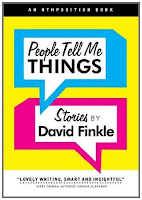
Review: People Tell Me Things by David Finkle

Title: People Tell Me Things
Author: David Finkle
Pages: 256
Genre: Contemporary Fiction, Short Stories
Release Date: November 1st, 2011
Publisher: Nthposition Press
Source: ARC Provided by Publisher

Everyone has been in a situation where a close friend or an acquaintance has begun telling a story. This story could be the retelling of an interesting interaction or the confiding of troubles with the intention of garnering advice. David Finkle's stories capture many of these moments through the eyes of multiple fictional narrators and put them into one collection. Each story centers around people influential in the New York City scene whether it be theater, art, writing, etc and the different eclectic events that happen in their lives.

My love of NYC is what attracted me to this collection initially. However, there wasn't a lot here to keep my attention. As with many short story volumes, some stories were much stronger than others. I particularly enjoyed "Rembrandt Paints Again" which focuses on a man who believes he has seen the famous painter on a city bus, makes his acquaintance, and eventually has his portrait painted by the stranger. There is a hint of magical realism that was a nice change of pace. "Stanley Konig Writing as Conrad Stamp" also caught my attention with it's social commentary regarding the effect of fame, although the critique was a little too obvious and lacked the nuanced insertion that some of the best stories utilize.

However, I wasn't too impressed overall. At first I wasn't sure if this was fiction and kept looking up all the names that were continually being dropped. I don't think I was the target audience as I didn't care too much about the problems of affluent city-dwellers. The stories were conversational, which I quite enjoyed, but the first person narration only served to unify everything instead of emphasizing that each narrator was a different person. This voice unification makes the collection a little boring and comes across as one person with way too many anecdotal stories.

While I wasn't too taken with this collection, there are bloggers who enjoyed it much more. I encourage you to check out the other stops on the tour and read their opinions.

About David Finkle

David Finkle has covered the arts for The New York Times, The New York Post, The Village Voice, The San Francisco Chronicle, The Nation, The New Yorker, New York, Time Out New York, Vogue, Harper’s Bazaar and The Huffington Post.


David Finkle’s TLC Book Tours TOUR STOPS:

Monday, November 7th:  Books Distilled
Wednesday, November 9th:  The Broke and the Bookish
Monday, November 14th:  Sara’s Organized Chaos
Tuesday, November 15th:  Life in Review
Friday, November 18th:  A Bookish Affair
Monday, November 21st:  Dolce Bellezza
Wednesday, November 23rd:  Take Me Away
Wednesday, November 30th:  Unabridged Chick
Thursday, Dec. 1st:  Sarah Reads Too Much 

Thursday, November 10, 2011

Review: The Language of Flowers by Vanessa Diffenbaugh

Title: The Language of Flowers
Author: Vanessa Diffenbaugh
Pages: 336
Genre: Contemporary Fiction
Release Date: August 23rd, 2011
Publisher: Ballantine
Source: Personal Copy

Have you ever read a book that you felt would have been more enjoyable or relatable if your own life circumstances were different?  That is how I felt when I finished The Language of Flowers. I even allowed some time to mull things over, and it only solidified my feelings. After seeing all the glowing reviews, I wondered why I didn't connect as much as other bloggers and reviewers did. For me, this book reinforces the idea that each reader brings his or her own life experiences to a book which greatly influences one's overall perception of the story and the characters.

The idea of the novel was my initial draw to The Language of Flowers. After being a ward of the state for eighteen years, Victoria Jones' solitary life is filled with anger, resentment, and mistrust. Once emancipated she must begin her life as an adult on her own. With no housing, no job, and no money, Victoria spends her time in a city park creating and tending to her own flower garden until she stumbles upon an opportunity to work for a local florist named Renata. Soon, Victoria begins to realize her talent for creating arrangements, and customers start asking for her by name. However, a chance encounter with someone from her past at the local wholesale flower market could change everything. Victoria must make a choice between a painful past or a potentially happy future.

Now, here's the part where I think my situation affected my enjoyment of the story and is a potential spoiler. At this stage in my life I don't have any children, nor do I plan to in the near future. That being said, the second half of the book is where I really lost interest. I guess I just lack that maternal instinct to really care about page after page of an infant's crying and feeding constantly. Also, I was not raised in the foster system, nor have I adopted a child so take my opinion with a grain of salt, but the protagonist's mean and spiteful attitude throughout the story despite being given multiple chances by genuinely caring people really started to bug me. I'm a firm believer that one's past does not define you or your future, but at every turn Victoria was quick use her years as a ward of the state as an excuse or justification. This is not to say that going through the system doesn't deeply affect a person, but I feel that with the right attitude and outlook on life that anyone can change their circumstances.

The Language of Flowers started out quite strong. I was a little skeptical about the main character's attitude, but was willing to play along. Diffenbaugh uses alternating chapters to tell two different storylines; one when Victoria is ten years old and the other in the present day. The idea that the Victorians actually sent messages through their flower choices to the extent that multiple flower dictionaries exist is fascinating. That was my original draw to the book, and I really wish the author had focused more on that angle. There was so much more about this topic to be explored, and I was really hoping to learn more than I did. Overall, I think my disappointment was a result of expecting a different type of book than what I read.

Wednesday, November 2, 2011

Review: Camp Nine by Vivienne Schiffer

Title: Camp Nine
Author: Vivienne Schiffer
Pages: 198
Genre: Contemporary Fiction
Release Date: October 10th, 2011
Publisher: University of Arkansas Press
Source: Review copy provided by publisher

If any of you are currently looking for the next selection for your book club, then please please please look into Camp Nine by Vivienne Schiffer. This absolutely stunning novel receives a (very rare) 5 out of 5 from me and is easily one of my favorite books this year! The writing is fantastic, and there are many controversial topics that would really engage a literary group.

These are the parts of my life: before Camp Nine and after Camp Nine, and those brief, unexpected days when Camp Nine was everything to me.
Camp Nine tells the story of Cecilia "Chess" Morton and her coming of age in the Arkansas Delta during World War II. Rook, Arkansas is an extremely rural farming town filled with prejudice, bigotry, and a strong division between the haves and the have-nots. While life is far from ideal, the appearance of an internment camp for Japanese Americans forced to leave their California homes quickly changes the town. When her mother Carrie takes a job inside the camp, Chess finds herself becoming involved in the lives of the prisoners and one family in particular, the Matsuis. Over the course of two years, Chess sees not only the triumphs and tragedies of a group of people who struggle daily with questions of sacrifice, loyalty, family, and tradition but also the unexpected dark secrets that lie within her own family's past.

The topic of the Japanese internment camps created by FDR during World War II is a part of US history that is often overlooked. I am so glad that Ms. Schiffer wrote such a compelling book that bring this subject into the forefront. The basic idea itself is just so unbelievable, and I can't even imagine the outcry if something like that were to have been suggested regarding American Muslims after 9/11. Based on the Rohwer Relocation Center, Camp Nine seems very well researched and translates into a very modern literary read.
I know that Camp Nine was something that should never have been. It destroyed lives and separated families...But the experience was mine, too. On a deeper lever than I had ever understood, Camp Nine has defined my life.
Once I started this book, I didn't want to stop. The writing of this Southern author and Arkansas native is magical. The setting came alive as I read, and I felt whatever emotion that the author conjures throughout the narrative. The subject matter first caught my attention, but it was the perfect amount of action and conflict that kept me reading. Little one-off lines of foreshadowing built a lot of excitement and increased my need to reach the novel's conclusion. While this story appears to be about a group of prisoners, Schiffer tackles the horrific and muddled situation through the eyes of a pre-teen girl. This is very much Chess' story. 

Again, I can't tell you enough about the competent and mesmerizing book that is Camp Nine. I definitely learned something about a topic that I wasn't too familiar with beforehand. I wholeheartedly encourage everyone to read Vivienne Schiffer's unforgettable debut. 


About Vivienne Schiffer

Vivienne Schiffer grew up in the Arkansas Delta town of Rohwer, site of the Rohwer Relocation Center, on which Camp Nine is based. She is an attorney and has practiced law for twenty-eight years in Houston, where she lives with her husband Paul and their family. Schiffer is currently at work on her second novel.

Tuesday, November 1, 2011

Review: The Night Circus by Erin Morgenstern

Title: The Night Circus
Author: Erin Morgenstern
Pages: 387
Genre: Contemporary Fiction
Release Date: September 13th, 2011
Publisher: Doubleday
Source: ARC

Billed as one of the must-read books of the fall, The Night Circus has been read and discussed by so many bloggers that I feel like my review will easily be passed over. I don't blame anyone, as I can't say I don't do the same sometimes with the more popular books at a given moment. However, the difference between my review and the many others out there is that mine will not be as glowing. If that has caught your attention then feel free to continue on or stop, whichever the case may be. I'm foregoing the posting of a summary, but if you have never heard of The Night Circus you can check out the synopsis on Goodreads.

Let's start out with the negative and get that out of the way. Not only was I greatly anticipating reading this book, but it was also my book club's October pick, so I had an excuse to read it sooner than I might have otherwise. Unfortunately, when I turned the last page I couldn't help feeling a little duped. Basically, I was a victim of all the hype and marketing surrounding the book, and I fear that my expectations were raised so high that they would never be met no matter what words lie between the covers. Where were the epic romance and the fierce battle promised on the jacket copy? For the most part the plot dragged in the middle, and I wish there had been more action to propel the story forward. The novel could have benefited from a little more focus and explanation of the origin of the competition between Hector and Alexander - not because I didn't understand the material, but because I think this would have integrated the necessary conflict more easily.

I will give credit to Morgenstern for her writing ability, especially considering this is her debut novel. While some of the descriptions were a little too long-winded to keep my full attention, I did feel that setting as well as the atmosphere depicted created quite a magical reading environment. The second person inserts definitely help immerse the reader in the circus. One of my favorite passages concerns the idea of storytelling:
Someone needs to tell their bits of overlapping narrative. There's magic in that. It's in the listener, and for each and every ear it will be different, and it will affect them in ways they can never predict. From the mundane to the profound. You may tell a tale that takes up residence in someone's soul, becomes their blood and self and purpose. That tale will move them and drive them and who knows what they might do because of it because of your words. That is your role, your gift.
While I wasn't as blown away as many reviewers, I did come away entertained. The book fit in quite nicely with the entrance of fall and the cold, crisp nights. Overall, I recommend The Night Circus hesitantly in the hopes that others will lower their expectations before diving in. I wish I had known to do the same.